Citation
Heise, M. (2000). Justice delayed?: An empirical analysis of civil case disposition time. Case Western Reserve Law Review, 50(4), 813–849. https://scholarship.law.cornell.edu/facpub/692/
Research Question
Which case- and court-level factors systematically influence how long civil cases take from filing to disposition, and do these empirical patterns support or contradict common assumptions about the causes of delay?
Key Takeaways
Civil case disposition time follows systematic patterns driven by case type and procedure, not random backlog; A relatively small subset of complex, motion-heavy cases accounts for much of overall delay; Mode of disposition (early dismissal, dispositive motion, trial) is a powerful predictor of how long a case stays on the docket; Popular claims that jury trials and generic court ‘congestion’ alone explain delay are overstated; Empirical timing patterns can be used by lawyers and courts to set realistic expectations and design targeted delay-reduction strategies
Dataset Description
The study uses administrative court records of civil cases from U.S. courts, tracking each case from filing date to disposition date. The dataset includes variables such as case type (e.g., tort, contract, other civil), filing and termination dates, disposition mode (e.g., settlement, dismissal, dispositive motion, bench or jury trial), and various procedural events, allowing calculation of disposition time in days. The unit of analysis is the individual civil case. The data spans multiple years before 2000 across one or more U.S. trial court systems, enabling multivariate statistical analysis of how case characteristics and procedural paths relate to elapsed time on the docket.
Methodology
statistical/quantitative
Key Findings
Heise finds that civil case disposition time is strongly patterned rather than random: a modest set of case-level and procedural characteristics explains much of the variation in how long cases take. Case type and procedural track are central; some categories (often simpler or more standardized matters) move quickly, whereas more complex categories and those with intensive motion practice tend to linger. Mode of disposition significantly predicts timing: cases resolved early through dismissals or dispositive motions terminate faster than those proceeding through extensive discovery and trial, especially jury trials. The analysis also shows that generalized “backlog” and broad claims about an overwhelmed system only partially explain delay; within the same courts, a small subset of cases accounts for a disproportionate share of elapsed time, indicating that delay is concentrated in complex, resource-intensive matters. Common assumptions that jury trials alone drive systemic delays are overstated: while jury trials are slow, the overall timing profile is more heavily shaped by case-selection effects, motion practice, and institutional procedures. The paper concludes that disposition time is empirically predictable at the case level and that lawyers, judges, and policymakers can use these patterns to manage expectations, reform procedures, and target interventions at the kinds of cases that drive most delay.
Summary
Heise’s article empirically examines how long civil cases take to move from filing to termination and what actually drives those timelines. Using administrative court data, the study converts disposition time into a measurable outcome and relates it to case characteristics such as type of claim, procedural path, and mode of disposition. Instead of treating delay as a vague symptom of “crowded dockets,” the article models time-to-disposition as a function of observable features of the litigation process.
The analysis shows that delays in civil litigation are structured and predictable rather than random. Certain categories of civil cases routinely resolve more quickly, while others predictably take longer, even within the same courts. The procedural trajectory of a case strongly influences timing: cases resolved by early dismissal or a dispositive motion exit relatively quickly, whereas those involving extensive discovery, multiple motions, and trial, especially jury trials, take substantially more time. Yet the study also finds that a relatively small proportion of complex, motion-intensive matters accounts for a large share of aggregate delay, so median times can appear modest even as specific cases experience long waits.
By testing conventional explanations, Heise shows that generalized backlog and jury trials, while relevant, do not, by themselves, account for the observed patterns. Institutional design and procedural rules, in particular, how motions are handled, how cases are scheduled, and how different tracks operate, shape disposition times more reliably than broad notions of “overloaded courts.” This recasts delay as an institutional and procedural phenomenon: it arises from predictable interactions between case complexity, party behavior, and court processes.
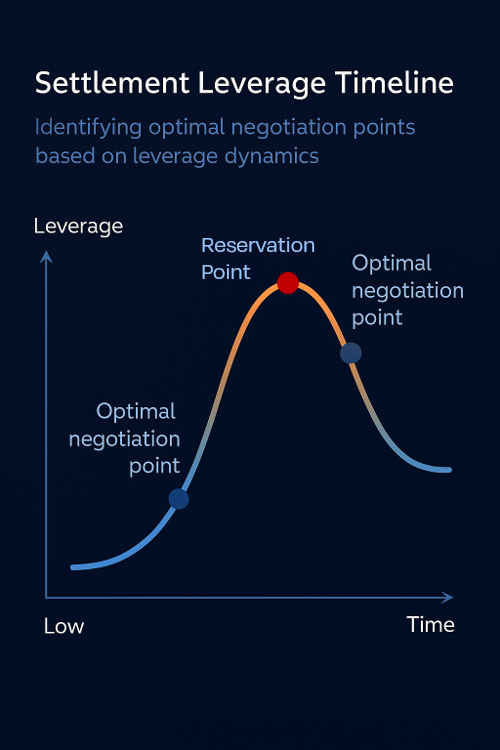
For practitioners and policymakers, the study demonstrates that disposition time can be forecast and, to a degree, managed. Lawyers can use historical timing patterns to advise clients, choose forums, calibrate motion practice, and anticipate when settlement leverage is likely to shift. Court administrators and reformers can focus delay-reduction efforts on specific types of cases and procedural chokepoints rather than treating the entire docket as uniformly congested. In doing so, the article illustrates how empirical analysis of court records can turn vague concerns about “justice delayed” into concrete, data-driven insights about how civil justice actually operates in time.
How the Study Advances Empirical Understanding of Legal Outcomes
The study finds that civil case disposition times follow structured and repeatable patterns driven by case type, procedural path, and mode of disposition, rather than by undifferentiated court congestion or random delay. The analysis shows that recognizing these regularities matters for understanding legal outcomes because elapsed time itself reflects how institutional procedures and case characteristics systematically shape when disputes are resolved. By grounding its conclusions in large-scale administrative court data and multivariate statistical analysis of case-level features, the study exemplifies an empirical, case-based approach to legal outcomes and decision environments, consistent with Pre/Dicta’s emphasis on rigorous analysis as a necessary component of high-level litigation practice.